05

Space: The Encounter of Life and Buddhist Art

Viewing Information

Period

April 2024 - present

Location

Gallery 5

Exhibits

Buddhist paintings, sculptures, etc.

We often use the word space in daily life, yet rarely pause to consider what it truly means. This exhibition explores the meaning of space through Buddhist art—an opportunity to reflect on how art and spirituality shape the spaces we live in, both around us and within us. bonte museum presents a calm and thoughtful environment where visitors can appreciate the beauty of Buddhist art while finding a quiet moment for reflection.
The exhibition unfolds across three distinct spaces: the first, Life Meets Buddhist Art, centers on Buddhist themes; the second, Infinity Road – Nirvana, reflects on the path toward spiritual transcendence; and the third, Life Meets Ancestral Culture, highlights the heritage of Confucian traditions. Together, these spaces invite visitors to fill the empty spaces within their own lives with reflection, serenity, and meaning.

List of Works

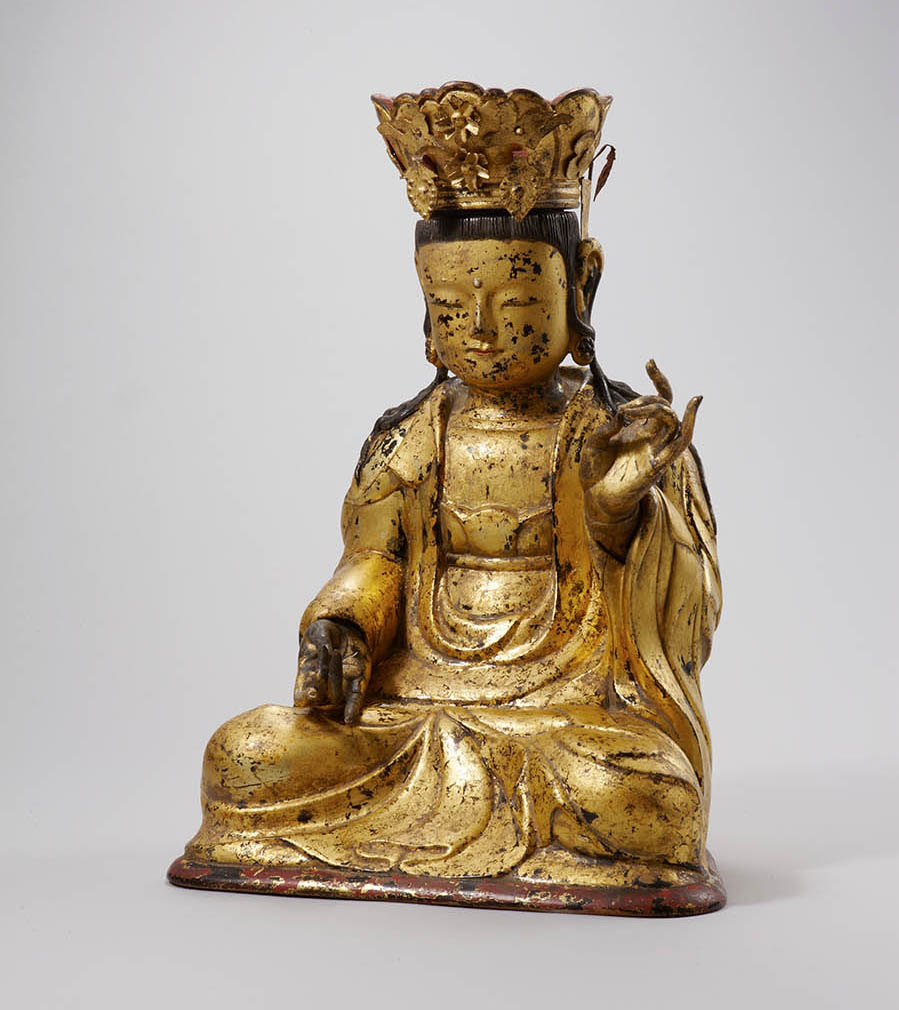
Wooden Bodhisattva Statue

Bulgam refers to a small-scale Buddhist temple. It originally meant a place in the grotto temple where a niche was carved into the wall to house and enshrine a Buddha or Bodhisattva statue for worship. Later, it also referred to the practice of creating a pagoda-shaped structure out of wood or metal to enshrine and worship the Buddha or Bodhisattva.
This Bulgam is made of wood. When opened, it reveals an Amitabha Buddha statue seated on a lotus-shaped pedestal in the center, separate from the Bulgam itself.

Painting of Dokseongdo

Dokseongdo refers to a Buddhist saint who conceals himself deep in the mountains to practice asceticism alone, embodying a solitary enlightened being and included within the category of the Sixteen Arhats. With Cheonhwa Mountain as its backdrop, the dignified figure exudes a solemn appearance. Against the backdrop of deep mountains and valleys, the solitary enlightened being is depicted seated imposingly upon a rock, effectively conveying the image of a self-awakened Arhat who has devoted himself to Buddhist practice in a remote hermitage for an extended period, as evidenced by his serene gaze. He is portrayed holding a rosary and a long staff in his left hand, while his right hand is raised to the right cheek, adorned with green ornaments, and draped in a red daegasa. A child attendant is also depicted at the bottom. Doksungdo is a unique Buddhist painting found only in Korea, vividly reflecting the characteristics of mountain Buddhism.

Folding Screen with Embroidery of Peony and Sanskrit

Sanskrit and peony patterns are harmoniously combined in the eight-panel folding screen. The mantra is recorded in Sanskrit, the ancient standard language of India. Over time, the letters of the Sanskrit mantra have transformed and been lost, and due to the characteristics of the bottle made with clay, the positions of the letters have also changed. It can be estimated that it is the 17th or 18th mantra of the "Avalokiteśvara Bodhisattva 42 Syllable mantra." The 17th mantra means, "If you want a son or daughter, sincerely recite this mantra." "Om Peony Mitra Svaha," and the 18th mantra means, "Om Peony Amrita Svaha," which means, "If you want to accomplish inexhaustible merit, sincerely recite this mantra." It can be inferred that the bottle was made with Sanskrit, excluding one letter that was omitted and another letter that was written differently.

White Porcelain in the Shape of Human Figurines

The white porcelain Buddhist figures and Pottery Human Figures represent a Chinese sculptural style that creates various figures of Buddha with ceramics. Although each figure is small, like a match head, they come together to show harmony. From the boldly expressed Boy Attendants to the delicately carved Bodhisattva, you can encounter a variety of works. 

Wooden Lion figurines

The lion, a divine animal that protects Buddhist law and truth, is depicted in scriptures as possessing the dignity and majesty of the Buddha, symbolizing the raising of sentient beings. Introduced to our country along with Buddhism, the lion has been actively used in various Buddhist-related sculptures, such as Buddhist pagodas, stone lanterns, and Stupas, often adorning the dais of Buddha statues. Lions are primarily featured as guardian figures protecting against evil, such as the Karma Mirror Stand, the Yeopcheungdae, which bears the weight of evil, and the Bukdae [Godae Gochwida], which receives the drumsticks. Additionally, lions are magnificently depicted on the dais and altars where Buddha statues are enshrined. These lions, even with their sharp teeth and glaring eyes, generally offer a friendly impression with their humorous appearance.

Wooden Miniature Shrine

A Buddha statue refers to the form of the Buddha, created as an object of worship in Buddhism. Buddha statues were not made during the Buddha's lifetime. They began to be created in India about 500 to 600 years after the Buddha's death and are generally believed to have been produced after the Gandhara period. It is believed that Buddhist statues were also produced in China around the 3rd to 4th centuries AD, when Buddhism was introduced. These Buddha statues are the central objects of worship in temples or sects and can be divided into statues of the Buddha, Bodhisattvas, Buddhist Guardian,  Arhat , Buddhist Patriarch. Each temple enshrines different Buddhas, and the forms and materials vary slightly depending on the era. You can view Buddha statues made with various forms and materials from the 17th century to the modern era.

Gallery 1

Traditional Craft

Gallery 2

Contemporary Art

Gallery 3

Chinjesulchan

Gallery 4

Traditional Funeral Rites

Gallery 5

Planned Exhibition

Outdoor

Sculpture Park

Go to top