02

Contemporary Art

Viewing Information

Period

Nov. 2012 - present

Location

Gallery 2

Exhibits

49 artworks

Gallery 2 welcomes visitors with the warmth of a private home-its residential structure evokes the feeling of being invited into the founder's personal space.

Within this intimate setting, visitors encounter works by iconic contemporary artists such as Nam June Paik, Yayoi Kusama, Robert Indiana, Julian Opie, Pablo Picasso and Salvador Dali, alongside Tadao Ando's quietly profound Meditation Room.

Here, contemporary art-so often perceived as distant or difficult-reveals itself naturally and comfortably. In this setting, visitors are invited to engage with the works not through theory, but through personal experience.

As Tadao Ando once reflected: "Even if you don't understand contemporary art, what matters is that the feeling of not understanding remain in your heart." We hope that in this uniquely personal space, you will take time to observe, reflect and discover your own way of seeing.

List of Works

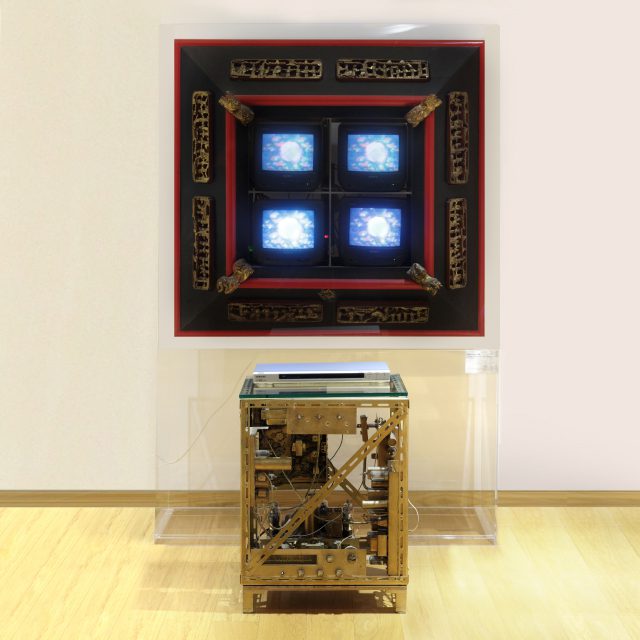
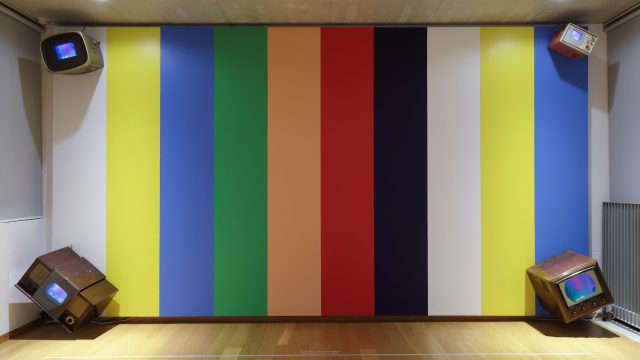
I never read Wittgenstein, 1998, Nam June Paik

Wittgenstein in the title is the spirit and representative figure of Western philosophy, and he defined the realm of speech as propositions that can be divided into true and false, with the exception of ethics and aesthetics, which he said could not be defined. The work is a witty expression of his philosophy, as if mocking it, and also a representative of Easterners, which shows his determination to do his art without conforming to Western philosophy.
A TV is installed at the four corners of the striped pattern that is broadcast during the screen adjustment time, and the TV shows a chaotic sequence of fragmented images that have no story or logical structure, which Wittgenstein could not define. By foregrounding the image of screen tuning, the artist is suggesting that Wittgenstein's logic is out of whack, and that our thinking needs tuning as well. 

Meditation Room, 2012, Tadao Ando

Tadao Ando often emphasizes the importance of constant contemplation and creating spaces that encourage thought. This philosophy is embedded even in the routes one takes to navigate the exhibition halls within bonte museum. Ando intended for visitors searching for the museum to meander through its corridors like a maze, taking their time to reflect, rather than following an efficient or logical path. The museum's layout, from the routes through the exhibition halls to the paths leading to the rooms, may seem inefficient and maze-like, but it embodies the architect's intention: to allow visitors to slow down, contemplate, and organize their thoughts as they encounter different spaces within the museum's maze.

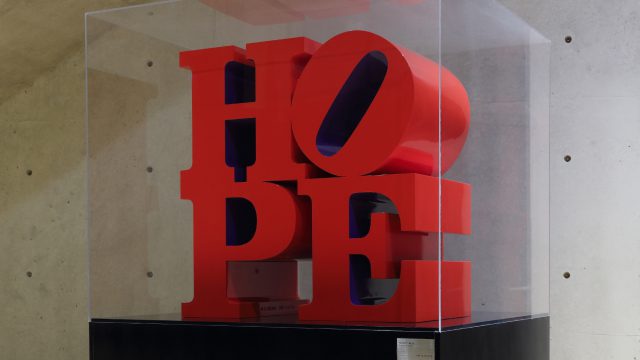
HOPE, 2009, Robert Indiana

Robert Indiana's works have been installed in about 50 countries around the world, becoming a must-see at various travel destinations. The artist, having received a request from the Museum of Modern Art (MoMA) in New York, first introduced the lettering ⟨LOVE⟩ for Christmas cards and received great affection from the public. However, due to the reason that ⟨LOVE⟩ is a word used by the public, he was not granted copyright for the work for a long time, and many works that plagiarized it were created until he obtained the copyright in 1998. The artist additionally presented the lettering series ⟨HOPE' with his own belief that love and the closest thing to it is hope, and donated all proceeds from ⟨Obama HOPE⟩ to Barack Obama's campaign. You can see Robert Indiana's ⟨LOVE⟩ and ⟨HOPE⟩ works, which conveyed the most appropriate message of hope through practice to all Americans, just like his own works. 

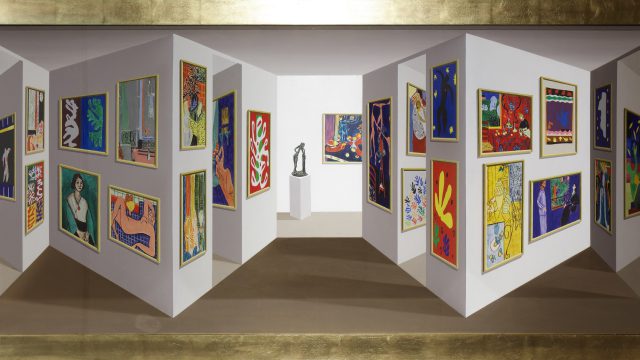
Matisse Fair, 2006, Patrick Hughes

Patrick Hughes challenges the conventional notion that what is near should be in front and what is far should be behind. By viewing Patrick Hughes's work from afar, up close, from the left, and from the right, one can observe how he completely subverts 'perspective,' revealing the distorted vanishing point of perspective. Within the artwork's imagery, the farthest point is actually closest to us, while the nearest point is farthest away. Furthermore, experiencing the artwork while moving from side to side allows one to witness a dizzying optical illusion, challenging the fixed idea that paintings are static and allowing a glimpse into the true essence of contemporary art. 

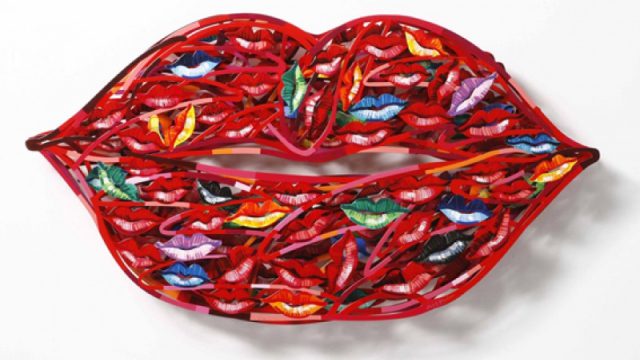
1000 Kisses, 2007, David Garstein

David Gerstein began his career as a children's book illustrator, and since then, his works are characterized by vibrant colors and lively, playful illustrative elements. Through his work, the artist aims to convey messages of hope and comfort to people, drawing inspiration from his own experiences. His creative method involves expressing the diverse aspects of subjects as a single entity, with dynamic and rhythmic curved elements adding to the unique quality of his pieces. The artist employs both painting and sculpture techniques, resulting in a dualistic reflection of two distinct characteristics: the flatness of painting and the three-dimensionality of sculpture. He laser-cuts his drawings onto steel or wood, arranging them three-dimensionally and directly coloring them to enhance the painterly aspect. This approach blurs the lines between painting and sculpture, adding an element of amusement. ⟨1000 Kisses⟩ evokes a bright and positive smile with its emphasis on curves and the harmonious blend of numerous entrances and vivid primary colors. 

Rondo in RGB, 1989, Nam june Paik

Nam June Paik is known as a prominent video artist, but he also studied music professionally and presented the fusion of music and art through numerous works.
⟨Rondo in RGB⟩ is a work created by combining the musical form of 'Rondo' and the artistic form of 'RGB'. 'Rondo' refers to a musical form in which a refrain is placed between different episodes, and the episode concludes with the theme. 'RGB' refers to the basic form of digital color, representing the three primary colors of light: red, green, and blue.
Images within a monitor based on RGB progress in a rondo form, visually expressing an element of music without any auditory stimulation, thereby presenting a 'false genre'. 

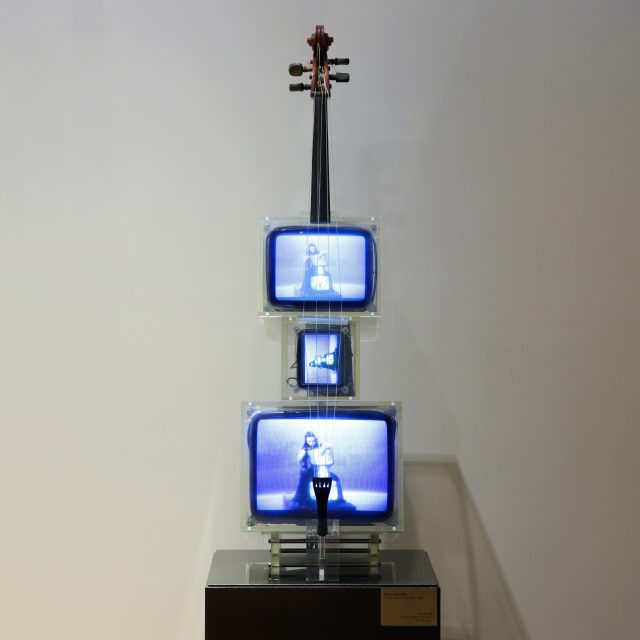
TV Cello (TV Cello), 1995, Nam June Paik

Nam June Paik first showcased a video collage called ⟨TV Cello⟩ for his Fluxus mentor Charlotte Moorman's performance. The early ⟨TV Cello⟩ was designed to allow an actual cello to be played, with the vibrations of the strings affecting a monitor that disrupted the image, creating changes. Paik's ⟨TV Cello⟩ and Moorman's performance combined to complete a single performance piece, and their performance is significant in that it showcased Fluxus's artistic concept of 'genre detachment' by integrating the art forms of visual art and music. Nam June Paik and Charlotte Moorman fearlessly presented groundbreaking performances as artistic collaborators. Moorman's provocative performances, such as appearing nude on stage or playing Paik, who appeared as a human cello, shocked audiences. In this way, Nam June Paik pioneered his unique art by breaking down conservative elements and completely shattering the stereotypes we take for granted. 

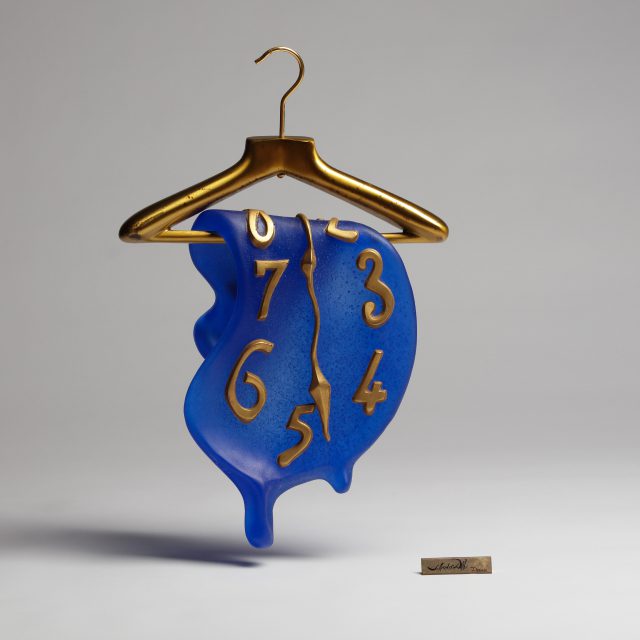
La Montre Molle, Salvador Dalí

As industrial revolutions surged, and a rational, efficiency-focused, ego-centric society faced the aftermath of world wars, artists who recognized the scars left by ego proposed 'the unconscious' as an alternative. The unconscious is an area where ego does not govern, and the expression of the unconscious could be their new alternative, emphasizing anti-ego. Salvador Dalí, perhaps the most well-known surrealist, primarily used images of the unconscious, images of dreams, spontaneously emerging without his control, in his paintings. With bizarre yet humorous imagination, he presented his unique world of art and established himself as a star in the art world, recognized for his genius. Dalí's 'The Persistence of Memory' first appeared in ⟨The Persistence of Memory⟩ and has become an iconic image representing surrealism. The image of melting clocks is interpreted by the artist as an unconscious image, containing symbolic meanings such as memories of his childhood and nostalgia. 

Gallery 1

Traditional Craft

Gallery 2

Contemporary Art

Gallery 3

Chinjesulchan

Gallery 4

Traditional Funeral Rites

Gallery 5

Planned Exhibition

Outdoor

Sculpture Park

Go to top